
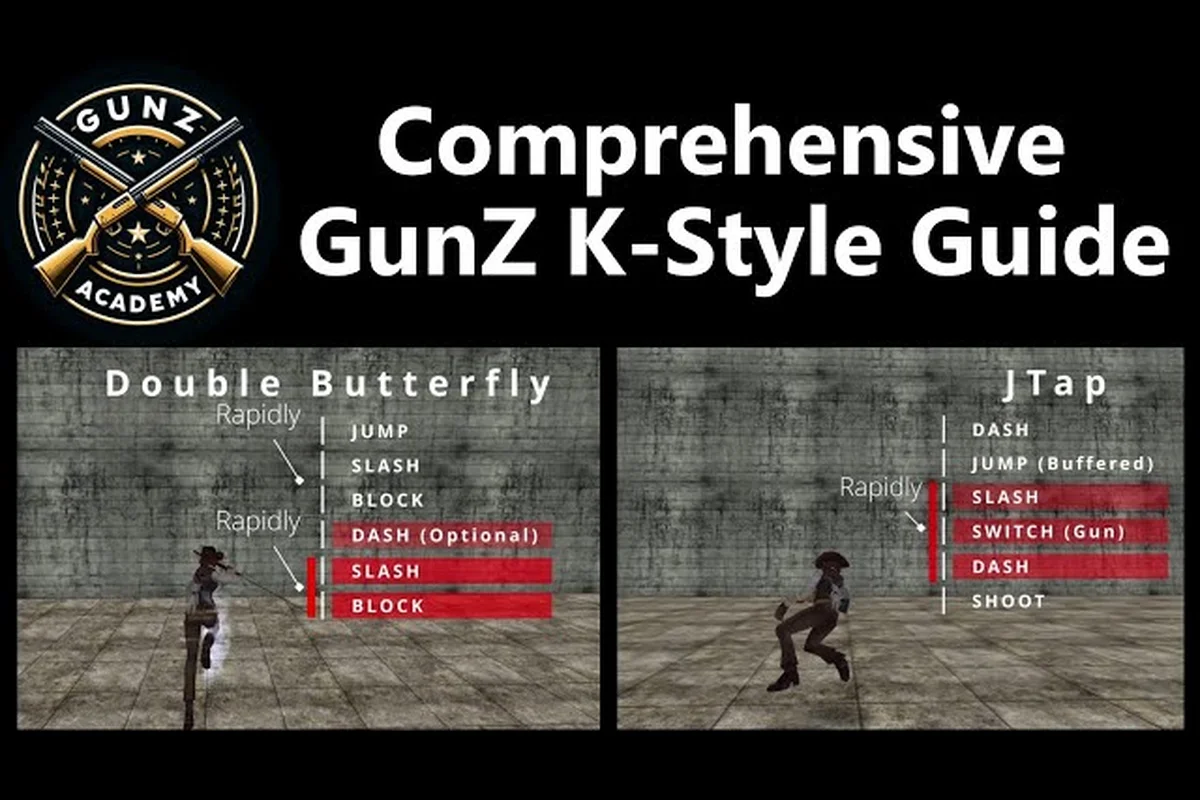
If you have ever watched a high-level GunZ: The Duel duel and wondered how players seem to teleport across the arena while swapping weapons mid-air, the answer is K-Style. This GunZ K-Style guide breaks down the wallrun dash cancel, the single most important movement technique that separates average players from those who control the pace of every fight. The official Steam page describes K-Style as the game's signature combat system—wall-running, acrobatic air combat, dashes, and a fluid mix of close-range and long-range weapons—and mastering it is non-negotiable if you want to win ranked matches. While the remaster preserves the classic feel and controls, the movement ceiling remains as high as it ever was, which means the players who invest time in training now will dominate the leaderboards for months.
The Wallrun Dash Cancel: Why This GunZ K-Style Tutorial Starts Here
The wallrun dash cancel is the foundation of every advanced movement chain in GunZ: The Duel K-Style. It is the technique that lets you convert a simple wall run into a burst of horizontal speed, and it is the prerequisite for nearly every combo you will learn afterward. Without this move, your K-Style will feel sluggish, and you will constantly lose positioning battles against players who have already internalized the input sequence.
The core idea is simple: when your character makes contact with a wall and begins the wall run animation, you cancel that animation with a dash input to launch yourself in a new direction. The timing window is tight, but once you understand the mechanics, you can chain wallrun dash cancels across entire maps without ever touching the ground.
The Exact Input Sequence for the Wallrun Dash Cancel
Before you can chain anything, you need to nail the basic input. Here is the sequence that every GunZ wall dash guide will teach you, broken down step by step: the key is that the wallrun dash cancel isn't a single button press but a tight two-part timing window. You initiate with a dash toward the wall, then immediately follow with a jump and a second dash input—typically bound to your right-click or a dedicated dash key—within roughly 100–150ms. This creates the "climb" that resets your dash cooldown mid-air, and the true K-Style mastery comes from alternating between your left and right strafe keys on each wall touch to maintain momentum. If you miss that second dash window, you'll just do a standard wall jump and lose all forward speed, which is why most GunZ K-Style tutorial breakdowns recommend practicing this against a flat, tall surface like the pillars in Mansion before ever attempting a full butterfly combo.
-
Approach the wall: Run toward any vertical surface at an angle, not straight on. A 30-45 degree approach angle gives you the most control over your exit trajectory.
-
Jump and press toward the wall: As you leave the ground, hold the directional key that points into the wall. Your character will stick to the surface and begin the wall run animation.
-
Wait for the wall run to register: You need to see your character's feet make contact and the animation start. This takes roughly 0.2 seconds, and pressing the cancel too early will just result in a normal jump.
-
Dash away from the wall: The moment the wall run registers, press the dash key (default is Shift) while holding a directional key that points away from the wall. Your character will launch off the surface with significantly more speed than a normal jump.
-
Follow up with a jump: Immediately after the dash cancel, press jump again to preserve your momentum in the air. This extends your distance and sets up your next input.
The most common mistake new players make is pressing the dash input too early or too late. If you dash before the wall run registers, you will simply dash into the wall and lose all momentum. If you wait too long, the wall run animation completes on its own, and you lose the speed boost entirely.
Timing Windows and Input Precision
The wallrun dash cancel is not a technique you can learn in five minutes. It requires muscle memory, and the timing window is unforgiving. Based on community testing and player reports, the effective cancel window is roughly 150-250 milliseconds after the wall run animation begins. That is a narrow window, and it is why this GunZ K-Style tutorial emphasizes repetition over theory.
| Input Component | Key Binding (Default) | Timing Window | Common Error |
|---|---|---|---|
| Wall Run Initiation | Directional Key + Jump | Instant on contact | Approaching at 90 degrees |
| Dash Cancel | Shift + Directional Key | 150-250ms after wall run starts | Pressing dash too early |
| Momentum Jump | Spacebar | Immediately after dash cancel | Forgetting the follow-up jump |
| Directional Control | WASD | Held throughout | Releasing keys mid-sequence |
The table above summarizes the core inputs, but the real challenge is consistency. You should expect to spend at least 30-60 minutes in a training room before you can execute the wallrun dash cancel reliably in both directions. Once you can do it without thinking, you are ready to move on to chaining.
Chaining Wallrun Dash Cancels for Continuous Speed
A single wallrun dash cancel is useful, but the real power of GunZ The Duel K-Style comes from chaining them together. When you chain the technique, you create a continuous loop of speed that lets you traverse the map faster than any other movement option. This is what players mean when they talk about "flow" in GunZ: The Duel—the ability to move from one wall to the next without losing momentum.
The chain works because the dash cancel preserves your horizontal velocity. When you land or hit the next wall, you carry that speed into the next wall run, which means the next dash cancel launches you even faster. In theory, you can accelerate indefinitely, though in practice map geometry and stamina limits cap your maximum speed.
The Two-Wall Chain Pattern
The most practical chain pattern for arena maps is the two-wall chain, which relies on alternating wall runs between two parallel surfaces to create a zigzag movement path. This pattern covers ground quickly while keeping you unpredictable, but its real value lies in how it sets up follow-up attacks: each wall run ends with a slash or a dash cancel, letting you enter a butterfly or half-step immediately after landing. On maps like Mansion or Prison, spacing the walls roughly 2–3 character lengths apart ensures your wall run doesn't lose momentum, and chaining a reload cancel between dashes keeps your ammo topped up without breaking the rhythm.
| Chain Step | Action | Result |
|---|---|---|
| Step 1 | Wallrun dash cancel on Wall A | Horizontal launch toward Wall B |
| Step 2 | Land and immediately jump into Wall B | Wall run initiates with preserved speed |
| Step 3 | Dash cancel off Wall B | Launch back toward Wall A |
| Step 4 | Repeat steps 1-3 | Continuous acceleration loop |
The key to this pattern is minimizing the time you spend on the ground. Every frame you spend running on the floor is speed lost. You want to land, jump, and hit the next wall as close to instantly as possible. This is where the GunZ wall running guide fundamentals come into play—your approach angle to each wall determines how much speed you retain.
Stamina Management During Chains
One of the most overlooked aspects of GunZ The Duel K-Style is stamina management. Every dash and wall run consumes stamina, and if you exhaust your stamina mid-chain, you will drop to the ground with no way to escape an opponent's attack. The stamina bar is your movement currency, and you need to budget it carefully.
| Movement Action | Stamina Cost | Notes |
|---|---|---|
| Wall Run (per second) | 10% | Continuous drain while on wall |
| Dash Cancel | 15% | One-time cost per cancel |
| Air Jump | 5% | Small cost, but adds up |
| Ground Dash | 20% | Most expensive single input |
Integrating the Wallrun Dash Cancel into Combat
Once you have the movement down, the next step is integrating the wallrun dash cancel into actual combat. This is where GunZ The Duel K-Style truly shines, because the technique is not just for traversal—it is an offensive and defensive tool that lets you control engagement distance.
The most powerful combat application is the wallrun dash cancel into a weapon swap attack. When you dash cancel off a wall, you are moving at high speed and your character is in the air. This is the perfect moment to swap from your sword to your gun, or vice versa, and catch your opponent with an attack they did not expect. The speed of the dash cancel makes your hitbox harder to track, and the weapon swap animation is hidden by the movement.
Offensive Patterns with Weapon Swaps
Here are the three offensive patterns that competitive players use most often, according to the GunZ: The Duel Hall of Fame rankings at gz.ludenus.com/rank, which track top competitive players and treat K-Style mastery as the core of ranked play:
-
Wallrun Dash Cancel into Sword Slash: Dash cancel directly into an opponent who is grounded. The speed of your approach makes your sword slash land before they can react, and you can follow up with a second slash or a dash away.
-
Wallrun Dash Cancel into Gun Shot: Launch off the wall, swap to your pistol mid-air, and fire a shot at your opponent's landing zone. This is a zoning tool that forces them to change their approach.
-
Wallrun Dash Cancel into Butterfly: If you have already learned the butterfly technique, you can chain the dash cancel into the butterfly's dash-dash-jump sequence for a devastating mid-air combo. This is an advanced pattern that requires significant practice, but it is one of the highest-damage openers in the game.
Defensive Applications and Escape Routes
The wallrun dash cancel is equally valuable as a defensive tool, particularly when you are cornered or outnumbered during a sword fight. By canceling the wallrun into a dash, you instantly change your momentum vector and can chain into a butterfly or half-step to break line-of-sight, creating an escape route that most opponents cannot follow because they are still committed to their attack animation or locked into a reload cycle. This is especially effective against shotgun users, whose reload window gives you a clean two-second gap to reposition and reset the engagement on your terms.
The most reliable defensive pattern is the wallrun dash cancel into a directional change. When an opponent commits to an attack, dash cancel off a wall at a 90-degree angle to their approach. This puts you behind them or to their side, and you can immediately counter-attack or create distance. Because the dash cancel is faster than a normal jump, you will often escape before their attack animation completes.
Another defensive application is using the wallrun dash cancel to reset a losing exchange. If you are taking damage in a melee trade, dash cancel away, land, and immediately re-engage from a new angle. This resets the engagement on your terms and forces your opponent to react to your movement rather than their own combo.
Wallrun Dash Cancel Practice Routines
Reading about the technique is one thing, but you will not improve without structured practice. This GunZ K-Style tutorial includes a set of training drills that progress from basic to advanced, and you should spend at least 15-20 minutes on each drill before moving to the next.
The most important principle is slow and deliberate practice. Do not try to execute the wallrun dash cancel at full speed until you can do it correctly at half speed. Speed comes from muscle memory, and muscle memory comes from repetition of correct inputs, not sloppy ones.
Drill Progression Table
| Drill Level | Drill Name | Objective | Success Criterion |
|---|---|---|---|
| Level 1 | Single Wall Cancel | Execute one clean wallrun dash cancel | 10 consecutive successful cancels |
| Level 2 | Two-Wall Chain | Chain cancels between two parallel walls | 5 full loops without touching the ground |
| Level 3 | Directional Control | Dash cancel in all four directions | 5 cancels in each direction consecutively |
| Level 4 | Combat Integration | Wallrun dash cancel into a weapon swap attack | Land 3 consecutive hits on a training dummy |
| Level 5 | Full Map Traversal | Chain cancels across an entire arena map | Cross the map in under 10 seconds |
Recommended Practice Routine
To build the muscle memory you need, follow this daily 30-minute routine, which is broken into three 10-minute blocks that mirror the GunZ wall dash guide's progression. Start with 10 minutes of solo wall-run reps in a training room to lock in the dash-into-wall jump timing, then spend 10 minutes chaining butterfly dashes across the Practice Map's pillars to internalize the momentum transfer. Finish with 10 minutes of live sparring against a bot, forcing you to execute the K-Style movement under pressure—this last block is critical because it converts deliberate practice into the reflexive reaction time that separates a basic wall run from a true K-Style combo in GunZ The Duel.
-
Warm-up (5 minutes): Execute single wallrun dash cancels on both your dominant and non-dominant sides. Focus on clean inputs, not speed.
-
Chain practice (10 minutes): Work on the two-wall chain pattern. Count your loops and try to beat your previous record each session.
-
Combat drills (10 minutes): Set up a custom match against a training dummy or a friend. Practice the offensive and defensive patterns from the previous section.
-
Free play (5 minutes): Enter a casual duel and try to use the wallrun dash cancel naturally in combat. Do not force it—let it emerge from your movement.
If you are serious about improving, you should also review your own gameplay. Record your duels and watch them back to identify moments where you missed a wallrun dash cancel opportunity. This kind of self-analysis is how you turn the technique from a conscious input into an automatic response.
Common Mistakes and How to Fix Them
Every player hits a plateau when learning the wallrun dash cancel, and the cause is almost always one of a few common mistakes. This section of the GunZ K-Style guide addresses the most frequent errors reported by players, along with concrete fixes.
| Mistake | Symptom | Fix |
|---|---|---|
| Dashing too early | Character dashes into the wall | Wait for the wall run animation to visibly start |
| Dashing too late | Wall run completes, no speed boost | Press dash within the 150-250ms window |
| Wrong approach angle | Character slides off the wall | Approach at 30-45 degrees, not 90 |
| Releasing directional keys | Character stops mid-air | Hold directional keys throughout the sequence |
| Forgetting the follow-up jump | Speed drops after the cancel | Always jump immediately after the dash cancel |
The most common mistake is dashing too early, and it is also the easiest to fix. The issue is that players anticipate the wall run and press dash before the animation registers. The solution is to slow down your inputs and focus on the visual cue—your character's feet touching the wall—before you press dash.
Another frequent issue is the approach angle. If you run straight at a wall, your character will not initiate a wall run at all; they will just slide down the surface. You need to approach at an angle, and the optimal angle is around 30-45 degrees. This gives your character enough lateral momentum to stick to the wall while still allowing a clean dash cancel exit.
Frequently Asked Questions
How long does it take to learn the GunZ K-Style wallrun dash cancel?
Most players need 3-5 hours of dedicated practice to execute the wallrun dash cancel reliably, and another 10-20 hours to integrate it into combat naturally. The learning curve depends on your prior experience with fast-paced movement games, but consistent daily practice of 30 minutes will produce visible improvement within a week.
Is the wallrun dash cancel necessary for ranked play?
Yes, the wallrun dash cancel is essential for competitive ranked play in GunZ: The Duel K-Style. Players who master wall-run and air combat movement outposition opponents who rely on basic movement, according to the official Hall of Fame rankings. Without this technique, you will struggle to keep up with experienced opponents who use it constantly.
Can I use the wallrun dash cancel with a controller?
Yes, the wallrun dash cancel works with a controller, though the input timing is slightly different due to analog stick movement. The key is binding your dash and jump buttons to easily accessible triggers or bumpers. Practice the same drills with your controller to build the same muscle memory.
What is the difference between a wallrun dash cancel and a wall jump?
A wall jump is a simple jump off a wall that preserves some momentum, while a wallrun dash cancel uses the dash input to cancel the wall run animation and launch with significantly more speed. The dash cancel is faster, covers more distance, and is the foundation for advanced chains.
Does the wallrun dash cancel work on all maps?
The technique works on any map with vertical surfaces, but it is most effective on arena maps with parallel walls and open spaces. Quest maps and PvE stages have more obstacles, which can interrupt chains. Practice on duel maps first, then adapt your movement to other map types.