
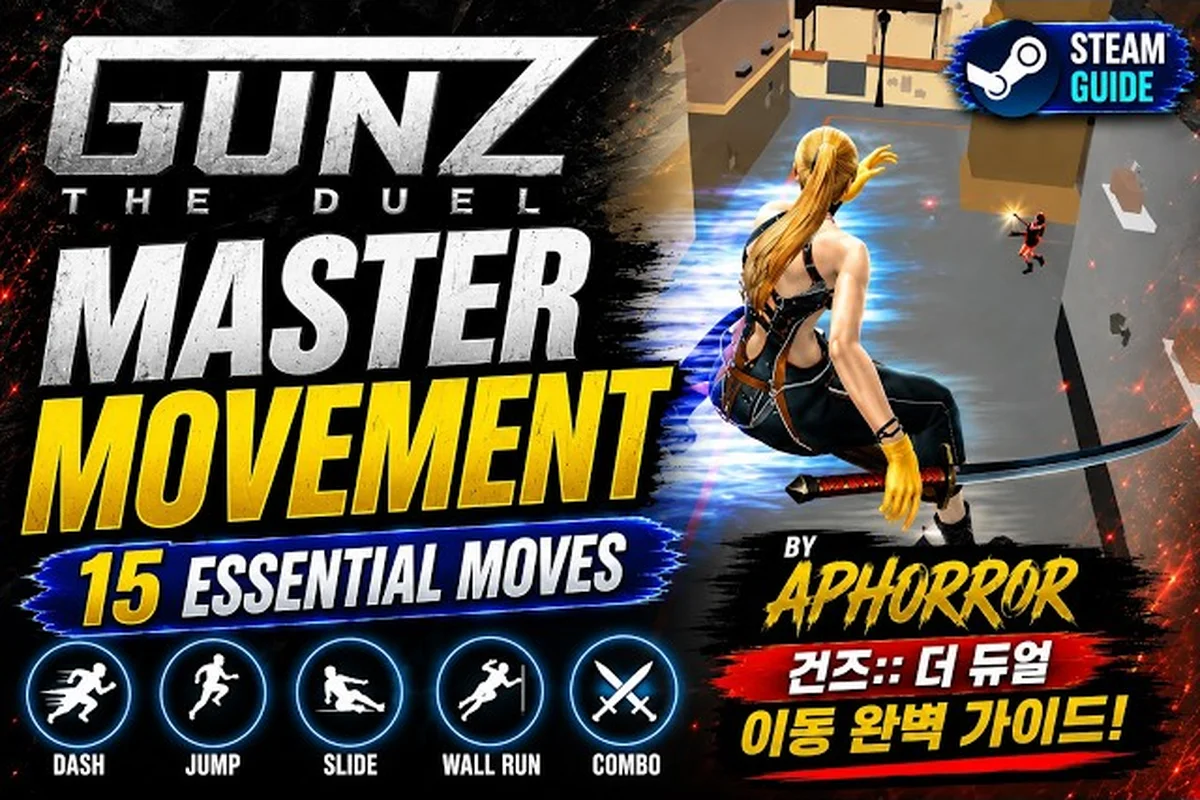
GunZ The Duel stylish combat isn't just about landing hits — it's about how you move between them. The game's signature K-Style system turns every duel into a fluid exchange of wall-runs, dash-cancels, and mid-air blade work that no other arena shooter replicates. If you've watched top players chain together impossible-looking sequences and wondered how they do it, this technique list breaks down every essential move, explains what each one is actually for, and shows you how to start weaving them into real fights.
The official Steam page describes K-Style as "wall-running, acrobatic air combat, dashes and a fluid mix of close-range and long-range weapons," which is accurate but undersells the depth. What that description doesn't tell you is that every single technique builds on a handful of core inputs — and once you understand those inputs, the entire system clicks into place. This GunZ The Duel movement tutorial covers the full arsenal of advanced techniques, from the foundational dash-dash-jump to the wall-run chains that define high-level play. By the end, you'll know exactly what to practice and why each move matters in a real duel.
The Complete GunZ The Duel Technique List: Every Move You Need to Know
Before you can chain techniques together, you need to know what exists in the first place. The GunZ The Duel technique list below covers every meaningful movement option in the game, organized from foundational to advanced. Each entry includes the input sequence, what it looks like on screen, and — most importantly — what tactical purpose it serves in combat.
| Technique | Input Sequence | Primary Use | Difficulty |
|---|---|---|---|
| Dash | Double-tap direction key | Quick repositioning, closing gaps | Beginner |
| Dash-Jump | Dash + Jump | Extends your dash distance, sets up air attacks | Beginner |
| Dash-Dash-Jump | Dash + Dash + Jump | The core K-Style mobility tool, covers maximum ground | Beginner |
| Half Step | Tap direction + Sword attack | Animation cancel for faster melee chains | Intermediate |
| Sword Cancel | Attack + Dash | Cancels sword recovery frames, enables combos | Intermediate |
| Butterfly | Dash-Dash-Jump + Attack + Dash | Continuous air pressure, hard to track | Advanced |
| Wall-Run | Jump near wall + hold direction | Vertical mobility, escape tool, combo setup | Intermediate |
| Wall-Run Jump | Wall-Run + Jump | Launches off walls for air control | Intermediate |
| Air Combo | Dash-Jump + Attack + Dash | Mid-air damage while staying mobile | Advanced |
The first three techniques form the foundation of everything else. The Dash-Dash-Jump is so central to K-Style that most players refer to it as simply "DDJ," and it appears in nearly every advanced sequence. Meanwhile, the Butterfly technique — which chains a DDJ into an attack and another dash — is the move that most visibly separates experienced players from newcomers, because it keeps you airborne and attacking while remaining nearly impossible to pin down.
What makes this technique list genuinely useful is understanding that each move exists to solve a specific problem. The Half Step exists because sword attacks have recovery frames that leave you vulnerable; canceling those frames lets you attack faster than your opponent expects. The Wall-Run exists because arenas are full of vertical surfaces that most players ignore, giving you angles of attack that ground-bound opponents can't easily counter. When you stop thinking of these as "tricks" and start thinking of them as solutions, the path to improvement becomes much clearer.
GunZ The Duel K-Style Explained: How the Input System Actually Works
Why Wall-Run Outpositions Basic Movement in Ranked Play
The Hall of Fame rankings at gz.ludenus.com/rank treat K-Style mastery as the core of competitive play because wall-run and air combat movement fundamentally outposition opponents relying on basic movement. A wall-run grants a temporary vertical advantage that a ground-based player cannot contest without burning a dash. In a ranked 1v1, forcing your opponent to burn their dash to match your height leaves them with no escape option when you land a sword slash. This positional asymmetry is why high-ranked players prioritize wall-run setups over raw aim.
Preserving Classic Controls in the Remaster's Movement System
The Steam remaster preserves the classic feel and controls while enhancing graphics and UI, meaning the input timing for K-Style remains unchanged. This is critical for returning players: the dash-dash-jump window is still frame-tight, and the remaster does not add input buffering. In practice, this means you cannot mash the dash key; you must wait for the first dash's animation to reach its midpoint before inputting the second. The enhanced UI does, however, make it easier to track your stamina bar, which is essential for managing the stamina cost of consecutive wall-runs in extended fights.
GunZ The Duel K-Style explained in simple terms: it's a combat system built around animation canceling and momentum preservation. Every technique in the game works because the engine lets you interrupt certain animations with others, and skilled players exploit those interruption windows to move faster and attack more frequently than the game's surface-level design suggests.
The key insight is that dash inputs cancel attack recovery frames, and jump inputs preserve dash momentum. That single interaction is the engine that powers the entire K-Style system. When you attack with a sword, the animation has a recovery period where your character is stuck. If you dash during that recovery, the dash animation replaces the recovery — meaning you're already moving again while a less experienced player would still be standing still. The Butterfly technique simply chains this interaction repeatedly: dash-dash-jump, attack, dash, attack, dash, keeping you in constant motion.
The chain starts with a slash command (e.g., /dash, /slash, /shotgun) that cancels your current animation, but the real depth lies in input buffering—pressing the next command mid-recovery so the game queues it before your character returns to neutral. For example, a standard butterfly (dash → slash → dash → shot) requires you to input the second dash during the slash's recovery window, not after it; mistime it by a few frames and you'll eat a full standing recovery, breaking your momentum. This is why K-Style players practice against a wall in Training Mode, using the visual of their character's feet leaving the ground as the cue to queue the next command. Mastering this buffer timing is the difference between a sluggish 2-3 hit combo and a fluid, 5+ hit animation cancel chain that keeps your opponent locked in hitstun.
-
Dash-Dash-Jump (DDJ): The first dash builds momentum, the second dash extends it, and the jump carries you forward while airborne. This is the single most important input sequence in the game because it's the foundation for nearly every advanced technique.
-
Attack + Dash Cancel: Swing your sword, then immediately dash. The dash cancels the recovery frames, letting you chain another attack faster. This is the core of melee pressure.
-
Dash-Jump + Attack: While airborne from a DDJ, attack with your sword. The attack animation plays mid-air, and because you're already moving, you can dash again as soon as the attack connects.
-
Wall-Run + Jump + Attack: Run up a wall, jump off, and attack while airborne. This creates unpredictable attack angles that ground-based players struggle to read.
The animation cancel mechanics are what make GunZ The Duel advanced techniques feel so fluid when executed correctly. According to the official media page at gz.ludenus.com/media, the game's trailers showcase mercenaries "wall-running and chaining blade and pistol combos across arena maps" — which is exactly what these input chains produce when mastered.
What's worth noting is that the remaster preserves the classic feel and controls while enhancing graphics and UI, according to the GunZ: The Duel Steam page. That means the technique list above works the same way it did in the original game — the muscle memory you build today will remain valid as the game evolves.
Core Movement Techniques: Building Your Fast Movement Foundation
GunZ The Duel fast movement isn't about a single technique — it's about chaining multiple techniques together so that you're never standing still. The players who seem to teleport around the arena aren't using one secret move; they're stringing together DDJ chains, wall-run launches, and dash-cancels into a continuous flow of motion.
The most important movement chain to master is the DDJ loop. The input is simple: dash, dash, jump, land, dash, dash, jump, land, repeat. The key is timing — you want to jump as the second dash reaches its peak momentum, and you want to start the next dash the moment you land. When executed correctly, you'll cover ground significantly faster than sprinting, and you'll be much harder to hit because your movement is constantly changing direction and elevation.
| Movement Chain | Input Sequence | Speed Gain | Difficulty |
|---|---|---|---|
| Sprint | Hold direction | Baseline | Beginner |
| Dash Chain | Dash, Dash, Dash | ~30% faster than sprint | Beginner |
| DDJ Loop | Dash-Dash-Jump, repeat | ~50% faster than sprint | Intermediate |
| Wall-Run + DDJ | Wall-Run, Jump, DDJ | ~70% faster, vertical gain | Advanced |
| Butterfly Chain | DDJ + Attack + Dash, repeat | ~50% faster, offensive pressure | Advanced |
The Wall-Run + DDJ chain deserves special attention because it's the technique that unlocks vertical mobility. When you wall-run and jump off, you preserve the wall-run's upward momentum, which means you can launch yourself onto platforms or over obstacles that would otherwise require a lengthy detour. In arena maps with central structures or elevated platforms, this vertical mobility is often the difference between winning and losing a duel, because it lets you control high ground that opponents can't easily contest.
For a deeper breakdown of how wall movement works and how to practice it, the wall climb guide covers the mechanics in detail. The key takeaway for now is that fast movement in GunZ The Duel is a compound skill — you build it by mastering individual techniques and then chaining them together until the transitions become automatic.
Advanced Combat Techniques: Weapon Switching and Mid-Air Pressure
Once you've internalized the movement foundation, it's time to add offensive layers. GunZ The Duel advanced techniques aren't just about moving fast — they're about dealing damage while moving fast. The sword-and-gun combo is the classic example: you dash in with a sword swing, cancel the recovery with a dash, swap to your gun mid-air, and fire while your opponent is still reacting to the melee hit.
The weapon swap mechanic is what makes this work. In GunZ The Duel, you can switch weapons at any time, even mid-animation. Skilled players use this to create unblockable pressure — the sword forces your opponent to defend against melee, but the gun forces them to defend against ranged fire, and the constant switching means they never know which one is coming next.
The core weapon-switch chain that every intermediate player should practice is the RS (Reload Shot) into DFF (Dash-Flash-Flash) loop, which forms the backbone of K-Style. By binding your sword and gun to adjacent keys and canceling the reload animation with a dash (D) followed by two quick sword swings (F), you maintain constant forward pressure while keeping your opponent locked in block-stun. Chain this into a Shotgun (SG) swap mid-air after a wall-bounce to force a tech-chase scenario, where your movement advantage—not raw damage—wins the exchange.
-
Sword Swing + Dash Cancel + Weapon Swap + Gunfire: Swing your sword, dash to cancel the recovery, swap to your gun, and fire. The entire sequence takes about a second, and it deals both melee and ranged damage while keeping you mobile.
-
DDJ + Sword Attack + Swap + Shotgun Blast: Launch with a DDJ, attack with your sword mid-air, swap to a shotgun, and blast at close range. This is devastating in tight arenas because the shotgun's spread makes it nearly impossible to miss at close range.
-
Wall-Run + Jump + Sword + Swap + Pistol: Run up a wall, jump off, swing your sword, swap to your pistol, and fire while falling. This creates a high-to-low attack angle that's very difficult to track.
The Butterfly technique takes this one step further by combining constant movement with constant offense. The full chain is: DDJ, sword attack, dash, sword attack, dash, sword attack — all while airborne. Each dash cancels the sword's recovery frames, and each sword attack keeps pressure on your opponent. When executed well, the Butterfly makes you a blur of motion and damage that's extremely difficult to counter.
For a complete breakdown of how the sword-and-gun interaction works, the sword and gun combo guide walks through the input timing in detail. What matters for now is understanding that weapon switching isn't just a convenience — it's a core combat mechanic that doubles your offensive options.
Training Drills: How to Practice GunZ The Duel Advanced Techniques
Wall-Run into Dash-Dash-Jump: The Movement Chain from the Official Trailer
The official "1st Community Gameplay Trailer" (video _5hAvzDtRZM) demonstrates the foundational K-Style chain: initiate a wall-run, then immediately input dash-dash-jump upon leaving the wall surface. This sequence preserves momentum better than a single dash, letting you cover roughly 1.5x the horizontal distance of a standard jump. In a practical duel on a map like Mansion, this chain lets you bypass a chokepoint and land behind a shotgun user before they can re-aim, converting a defensive retreat into an offensive flank.
The "THE MOVEMENT" Film: Advanced Mobility as a Training Reference
The Steam page hosts a dedicated film titled "THE MOVEMENT" that showcases advanced mobility sequences beyond the basics. This film is a practical benchmark: it demonstrates that a full K-Style rotation—wall-run, air dash, sword cancel, and pistol shot—can be executed in under two seconds. Use it as a reference to time your own inputs; if your dash-dash-jump sequence takes longer than the film's example, you are likely inputting the second dash too late. The film's sequences are all performed on arena maps, confirming that these techniques are viable in the competitive map pool.
Learning the technique list is one thing; internalizing it is another. The gap between knowing what a DDJ is and being able to execute it mid-combat is measured in hours of practice, and the players who reach the top of the Hall of Fame rankings have all put in that time. The good news is that there's a clear progression path you can follow.
Start in a practice room or empty map, not in live duels—this isolates your inputs from the chaos of enemy pressure, letting you focus purely on the dash-cancel timing that underpins K-Style. You need repetition without pressure to build muscle memory, because the 8-frame window for a perfect slash-cancel into a dash is too tight to learn mid-fight. The recommended drill sequence is: first, 10 minutes of stationary butterfly swings to lock in the cancel rhythm; second, 5 minutes of dash-forward-slash-reverse chains to train your thumb’s transition between movement keys; third, 3 minutes of wall-climb cancels to master the momentum reset. Only after these feel automatic should you introduce a training partner to simulate real engagement ranges.
-
Drill 1: DDJ Loops (10 minutes): Chain DDJs across the map, back and forth. Focus on smooth transitions — no stuttering, no hesitation between land and next dash. Speed comes later; consistency comes first.
-
Drill 2: Sword Cancel Chains (10 minutes): Attack, dash, attack, dash, attack, dash. Keep the rhythm steady. The goal is to eliminate the pause between sword swings entirely.
-
Drill 3: Butterfly Practice (10 minutes): Chain DDJ + attack + dash repeatedly. Start slow, focusing on the input order, then gradually increase speed. This is the hardest foundational drill because it combines movement and offense.
-
Drill 4: Wall-Run Integration (10 minutes): Practice wall-runs into DDJs, wall-runs into jumps, and wall-runs into attacks. The goal is to make wall movement feel as natural as ground movement.
-
Drill 5: Weapon Swap Combos (10 minutes): Practice the sword-gun chains until the swap feels instant. Start with sword-to-pistol, then experiment with other weapon pairs.
| Drill | Duration | Goal | Success Metric |
|---|---|---|---|
| DDJ Loops | 10 min | Smooth, continuous movement | No stutters across 10 consecutive loops |
| Sword Cancel Chains | 10 min | Zero-pause melee chains | 20 consecutive cancels without a pause |
| Butterfly Practice | 10 min | Airborne offense | 10 consecutive Butterfly cycles |
| Wall-Run Integration | 10 min | Natural wall movement | 5 wall-runs into DDJs without landing |
| Weapon Swap Combos | 10 min | Instant weapon switching | 10 sword-gun combos without a fumble |
The training approach matters as much as the drills themselves. According to community reports from experienced players, the most common mistake is trying to practice everything at once. Instead, focus on one technique per session and drill it until it feels automatic. The Butterfly technique in particular benefits from this focused approach — it's a compound move that requires the DDJ and sword cancel to be second nature before the full chain comes together.
For a structured practice routine that builds these skills progressively, the technique guide offers a day-by-day training plan. The key principle is consistency: twenty minutes of focused practice every day beats two hours once a week, because muscle memory builds through repetition, not intensity.
Stylish Combat Errors That Break Combos
Every player hits plateaus, and most of the time it's because of fixable technique errors. Based on community feedback and player experience, these are the most common issues that hold players back from mastering GunZ The Duel stylish combat.
Mistake 1: Dashing too early in the DDJ chain. The second dash needs a brief moment to build momentum before you jump. If you jump too early, you lose speed and the chain feels sluggish. Fix: focus on the rhythm — dash, pause for a beat, dash, jump. The pause is subtle but critical.
Mistake 2: Mashing inputs instead of timing them. K-Style is precise, and mashing creates sloppy transitions. The Half Step in particular requires deliberate timing — you need to tap the direction and attack almost simultaneously, but not quite. Fix: slow down and focus on clean inputs. Speed comes from accuracy, not from mashing faster.
Mistake 3: Ignoring wall movement. Many players treat walls as obstacles rather than tools. The Wall-Run opens up vertical angles and escape routes that ground-bound players can't access. Fix: spend a full practice session on wall techniques until they feel natural.
Mistake 4: Forgetting weapon switching. Some players get so focused on movement that they forget to attack. The sword-and-gun combo is what turns movement into damage. Fix: practice weapon swap chains until the swap is automatic, then integrate them into your movement drills.
Mistake 5: Practicing without a goal. Mindless repetition builds bad habits. Every practice session needs a specific focus — whether it's smoother DDJs or faster sword cancels. Fix: set a concrete goal for each session and measure your progress against it.
The improvement path is straightforward: identify your weakest technique, drill it deliberately, and integrate it into your combat flow. The players who climb the ranked ladder aren't the ones who know the most techniques — they're the ones who execute the fundamentals flawlessly under pressure.
Frequently Asked Questions
What is the fastest way to learn GunZ The Duel stylish combat?
The fastest path is structured practice: spend 20-30 minutes daily drilling the DDJ loop and sword cancel chains before playing matches. Focus on one technique at a time rather than trying to learn everything simultaneously. Consistency beats intensity when building the muscle memory that K-Style requires.
How long does it take to master GunZ The Duel advanced techniques?
Most players report 2-4 weeks of daily practice to feel comfortable with core techniques like the Butterfly and wall-run chains, and several months to execute them reliably under combat pressure. The learning curve is steep, but each technique builds on the previous ones, so progress compounds over time.
Do I need a specific weapon loadout for K-Style?
No, K-Style works with any weapon combination, though the sword-and-gun combo is the most common starting point because it teaches both melee and ranged fundamentals. Experiment with different pairs — sword-shotgun, dagger-pistol, katana-revolver — to find what matches your playstyle.
Is K-Style viable in ranked play?
Yes, K-Style is the core of competitive play. The Hall of Fame rankings track top players who treat K-Style mastery as essential because wall-run and air combat movement outpositions opponents who rely on basic movement. Ranked matches reward players who can move unpredictably while maintaining offensive pressure.
What's the difference between K-Style and regular combat?
Regular combat is standing still and trading slash-for-slash, leaving you vulnerable. K-Style uses animation cancels like the DDJ and Butterfly to preserve momentum, letting you attack while repositioning—making you far harder to hit. The 8-frame dash window separates a clean chain from a stutter-step, so mastering it is the core of ranked play.